
Your AI interview: what to expect
You applied. You deserve to be read, not filtered out by vocabulary.
A company you applied to uses Rubrily to run its first interviews. Here’s exactly what will happen, how you’ll be scored, and what happens to your recording, so you can walk in prepared, not surprised.
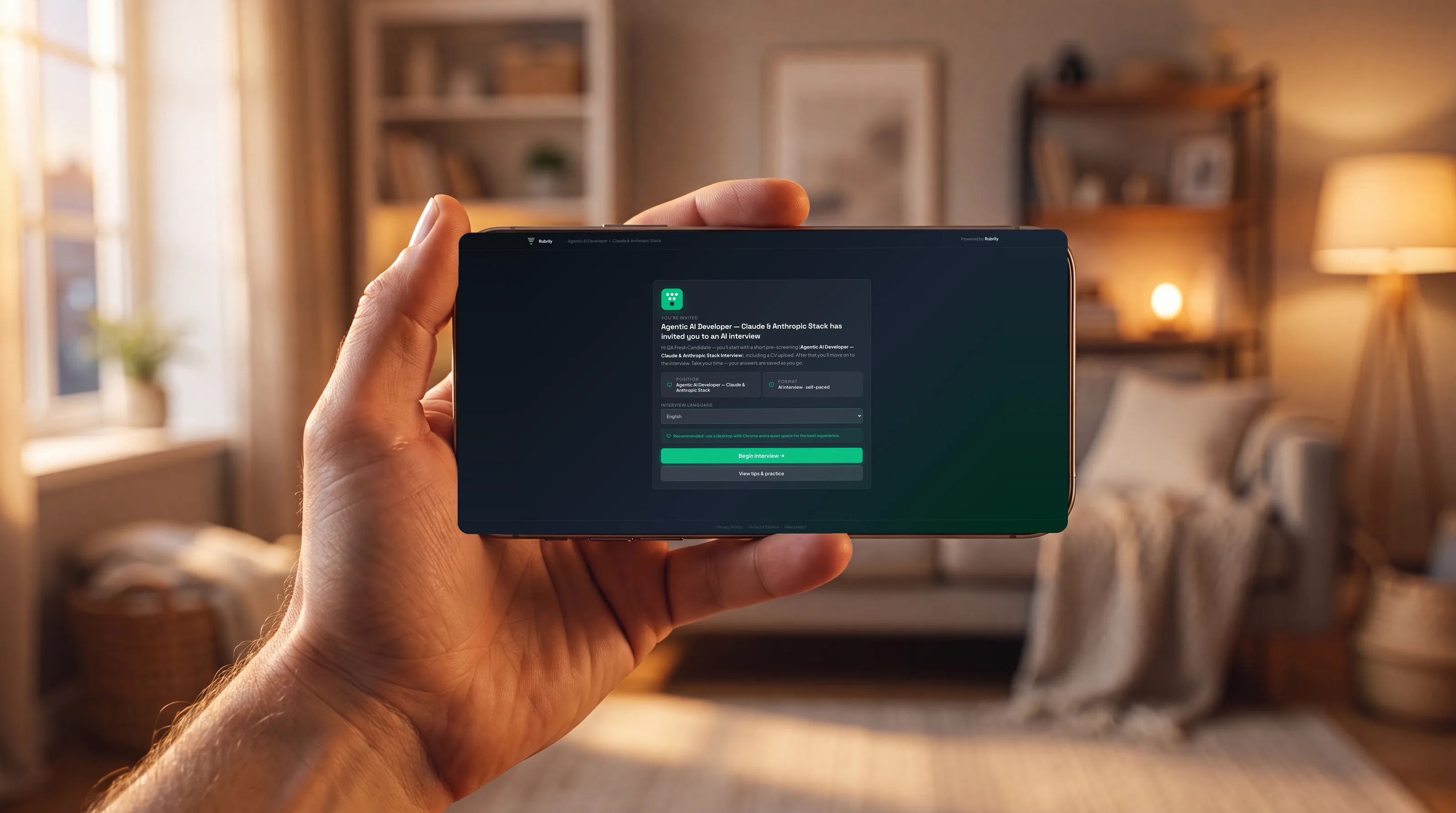
Step by step
- 01
You get an invitation link.
It shows the role, the format, and the duration before you commit to anything.
- 02
Pick your interview language.
Choose from the languages the employer enabled and interview in the language you're strongest in.
- 03
Practice first if you want.
A free walkthrough shows you the flow and interface before anything counts.
- 04
Answer a few quick questions and upload your CV.
The pre-screening takes a couple of minutes.
- 05
Give your consent.
The interview is recorded and monitored. You'll see the exact conditions and tick your agreement before any recording starts. No consent, no recording.
- 06
Take the interview, at your pace.
Questions are read aloud; you answer by speaking. You control when to record each answer, there's a visible timer, and your progress saves as you go. The AI may ask a follow-up based on what you said: that's it engaging with your answer, not a trick.
Tips: use a desktop with Chrome, find a quiet spot, and give yourself the full duration without interruptions.
What should I expect in an AI interview?
Expect a self-paced, recorded conversation: questions asked aloud one at a time, spoken answers, a visible timer, and possibly an adaptive follow-up. There’s no panel and no scheduling. You pick the moment. Your answers are transcribed and scored against the same criteria as every other candidate for the role.
How you’re scored and why it’s fairer
- Every candidate gets the same interview. Same questions, same rubric, same weights, so your score isn't shaped by an interviewer's mood or the time of day. And you can take a free practice run first: no grading, just the format.
- You're scored on evidence, with reasons. Each criterion gets a score with a written justification the employer can read, not a gut feeling.
- Missing data doesn't count against you. If there isn't enough signal to judge something, the system says "Cannot evaluate" rather than scoring it zero.
- A human makes the decision. The AI screens and explains; the hiring team reviews your report (including your actual recording) and decides.
Practice options

Can I practice first?
Yes, free. The Quick Walkthrough shows the interview flow and interface, step by step, before anything is graded. Some employers also enable Premium Practice, an optional paid session with realistic questions, real scoring, and personalized feedback. It’s never required, and skipping it doesn’t affect your interview.
Your data
You consent explicitly before recording, and the consent screen tells you what’s collected: your recording, transcript, CV, and pre-screening answers, all used to assess you for the role you applied to, and visible to that employer. You can request your data or its deletion; erasure requests are honored. Details: candidate privacy notice.
Is my data safe?
Your interview data belongs to your application: it’s stored in the employer’s isolated workspace, isn’t shared across companies, and client-shared reports scrub personal identifiers. Recording only happens after your explicit consent, and you can request deletion of your personal data under the candidate privacy notice.