
Fit Score
One number you can defend to anyone.
The Fit Score blends CV and interview into a 0–100% ranking. Every point traces back to a criterion, a justification, and the transcript it came from. When evidence is missing, it says "Cannot evaluate." It never guesses.
What is a Fit Score?
A Fit Score is a 0–100% score that blends a candidate's AI CV evaluation and AI interview results into a single ranking number. Each component is scored 0–10 per criterion against your weighted rubric, with a written justification, so every Fit Score can be traced back to specific evidence.
How AI candidate scoring works in Rubrily
- 01
Every criterion gets a 0–10 score with a written justification.
The AI evaluates the CV and the interview independently against your rubric and writes down why it gave each score, citing what it found.
- 02
Your weight tiers shape the rollup.
Each criterion carries a tier (Must Have, Very Important, Important, or Good to Have), so a weak Must-Have hurts far more than a weak nice-to-have. Each engine rolls up to a weighted 0–10.
- 03
You control the CV-vs-interview blend.
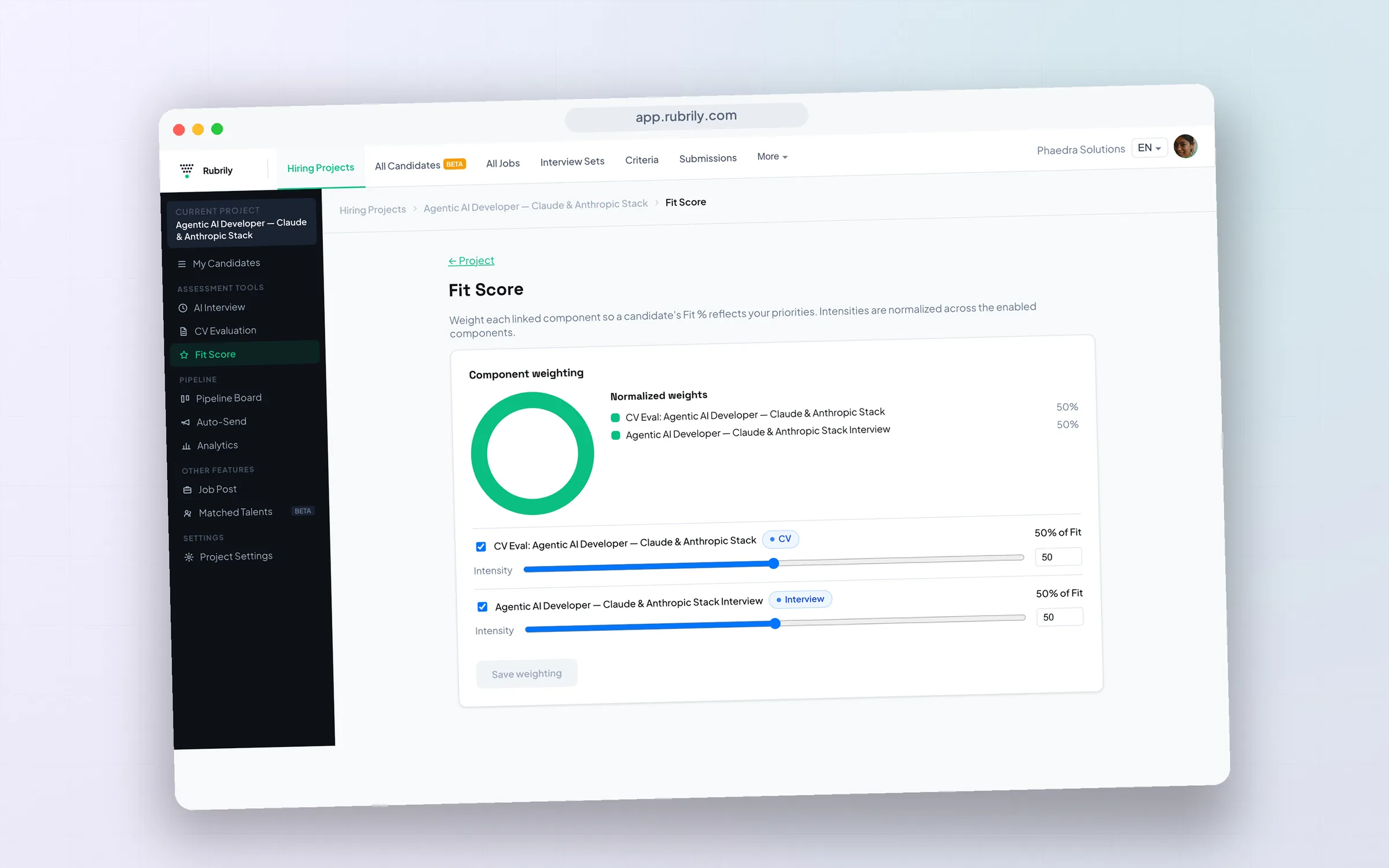
Per project, set each component's intensity; Rubrily normalizes to 100% total weight. A code-heavy role can weigh the interview higher; a portfolio role, the CV.
- 04
The blend becomes the Fit Score.
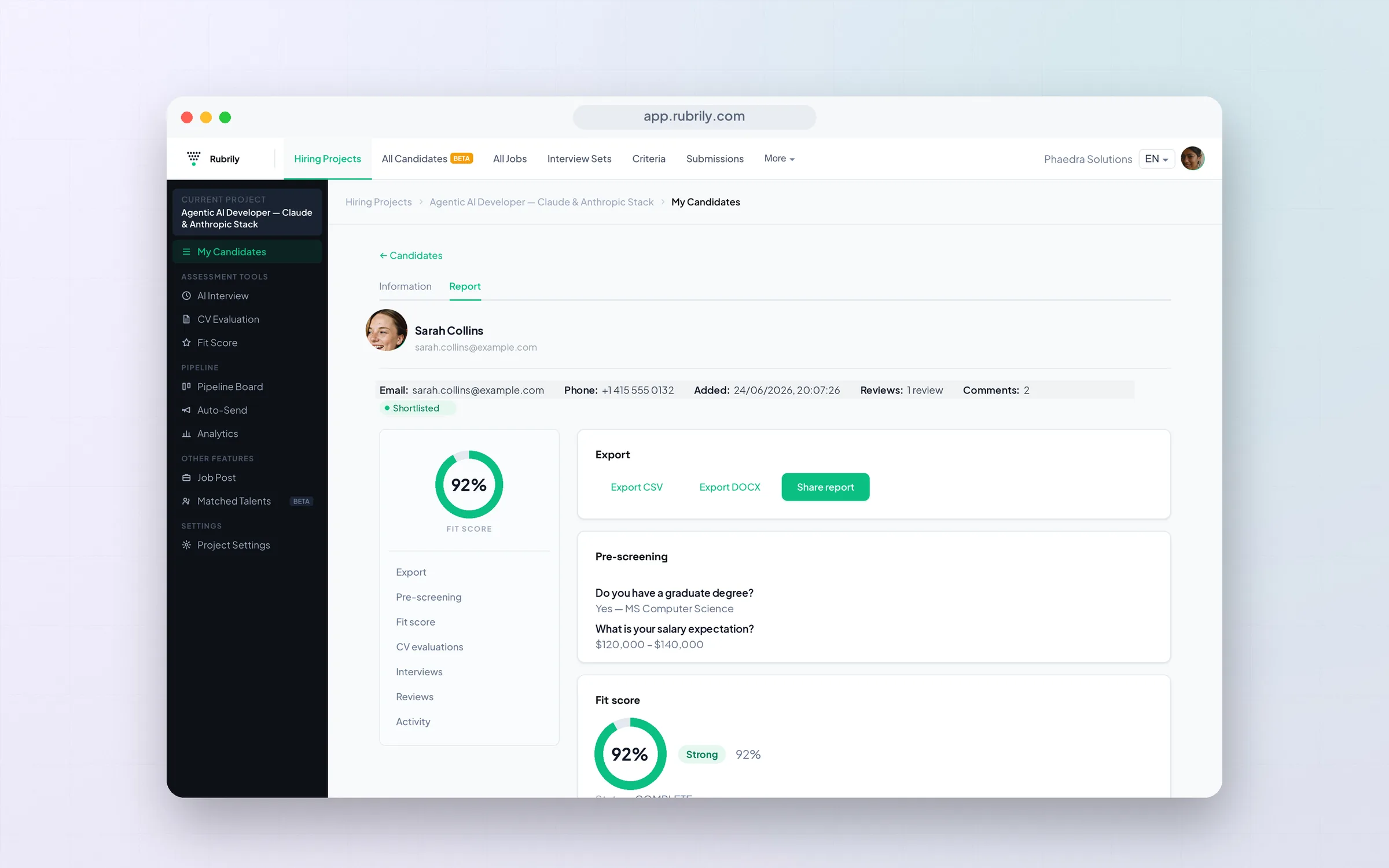
CV and interview scores combine into 0–100%, shown with its full component breakdown. Weighting is project-scoped: the same assessment can produce different Fit Scores in different roles, because fit depends on the role.
How are the weights set?
You set weights twice: per criterion, via four tiers (Must Have → Good to Have) that control how much each criterion moves its component score; and per project, via intensity sliders that control how the CV and interview components blend. Rubrily normalizes everything to 100% automatically.
When the AI can't evaluate, it says so.
Why "no fabricated scores"?
Because a guessed number is worse than no number. When there isn’t enough signal (a missing CV section, an unanswered question), Rubrily returns “Cannot evaluate” for that criterion instead of inventing a score. A missing answer is treated as missing, not as zero, so candidates aren’t silently punished for gaps in data.
Everything downstream inherits this: rankings, reports, and shared links only ever contain scores the AI could justify.

Click any score and see its reasons.
Every Fit Score decomposes: gauge → component scores → per-criterion 0–10 rows → written justifications → the transcript and recording they came from. So “why is she ranked third?” takes one click to answer, not a meeting. The report adds a narrative summary citing specific evidence, plus Strengths, Gaps, and Recommendations for follow-up interviews.
Is AI candidate scoring fair and auditable?
In Rubrily, every candidate for a role is scored against the same rubric with the same weights, which removes the biggest inconsistency in manual screening. Every score carries a written justification you can audit, the full transcript and recording are one click away, and the hiring decision always remains with your team.
Fit Score
Frequently asked questions
What is a Fit Score?
Can I change the CV/interview weighting?
What happens when the AI can't evaluate something?
Do recruiters see why a score was given?
Works with
Never say "trust me" in a shortlist meeting again.
Define your rubric once: every candidate gets scored against it.