
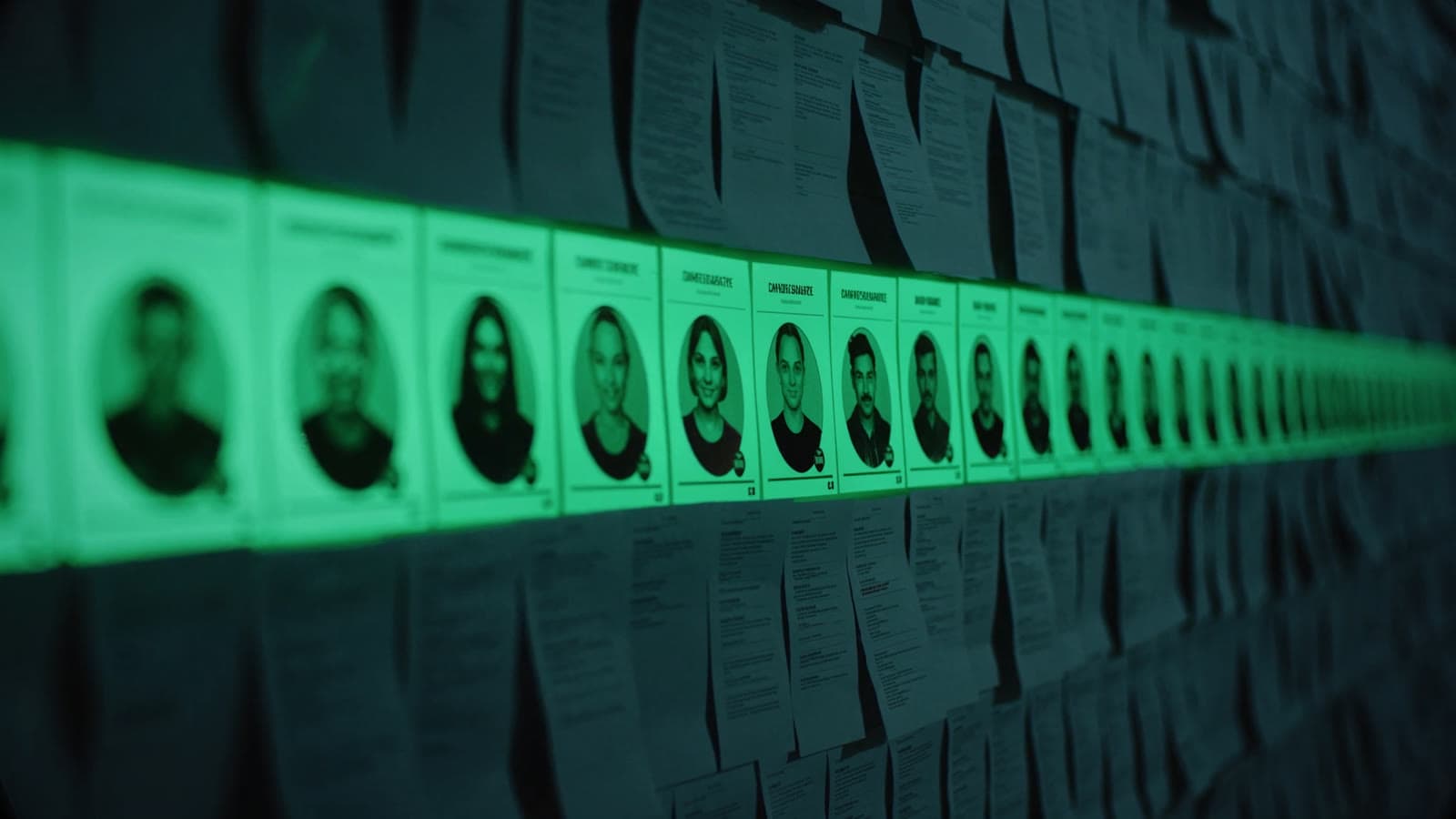
A single good job post can pull a thousand applications. Nobody staffs for that, so the real screening process at volume becomes a set of quiet compromises: skim until time runs out, filter by keywords and hope, interview whoever survived, and try not to think about the pile. Burnout isn't a personal failing in high-volume recruiting; it's the arithmetic.
This piece does the arithmetic honestly, then lays out a workflow where volume stops being the enemy. (Shopping for the tooling instead? Start with the best AI ATS tools in 2026.)
Where the hours actually go
Take 1,000 applicants and give each CV a genuinely careful read (call it three minutes). That's 50 hours: more than a full week of nothing but CV review, for one role, before a single conversation. Now screen the plausible top slice, say 150 candidates, with 30-minute calls at roughly an hour each all-in (scheduling, the call, notes, context switching): another 150 hours. Four weeks of full-time work, for one role's first round, assuming nobody reschedules and quality never dips. It does dip, of course: review number 300 does not get the attention review number 30 got, and evening scoring from memory is where consistency goes to die. And the no-reschedule assumption is the most generous of all: at documented ghosting and no-show rates, a real slice of those 150 booked hours evaporates unspent.
So teams cut corners, and each corner has a name. "Skim the first page" throws away everyone whose evidence lives on page two. "Keyword filters" reject your best nonstandard candidates and reward buzzword stuffing. "First 200 applications only" makes speed-to-apply a hiring criterion you never chose. The pile always gets processed. The question is whether by evaluation or by attrition.
The workflow that survives volume
The fix is not more discipline; it's moving the volume-scaling work to machines that don't degrade, and spending human hours only where they change the decision.
Define once (human, ~2 hours). Write the rubric (5–8 weighted criteria) and the interview question set mapped to it. This is the highest-leverage two hours of the whole hire, and it's reusable for every future opening of the role.
Screen everything (machine, ~0 human hours). Every applicant gets an AI CV evaluation against the rubric and an invitation to an async AI interview, running in parallel, on their own time, in their own language. Every answer and every CV comes back scored 0–10 per criterion with written justifications. Note what changed: coverage went from "top slice, if we're honest" to everyone, and consistency went from decaying to constant. Candidate 1,000 is evaluated exactly like candidate 1.
Review the shortlist (human, ~4–6 hours). The pipeline is now ranked by Fit Score. Read the top reports deeply (justifications, transcripts, flagged gaps) and spot-check the middle band plus a sample of "Cannot evaluate" cases (missing data, not weak candidates: the honest system refuses to guess). Move the genuine top into human interviews.
Spend interview hours where they decide (human). Your calendar now holds second conversations with evidenced finalists, each arriving with a scored report and probing suggestions, instead of first conversations with hopefuls chosen by skim.
How long does it take to screen 1,000 applicants with AI?
Human time drops from roughly 200 hours of reading and calls to a few hours of setup and shortlist review; the machine work runs in parallel and finishes as fast as candidates complete their async interviews: typically days, bounded by candidate response time rather than recruiter capacity.
What volume stops costing you
Beyond the hours, three quieter costs disappear. The guilt pile. Everyone got evaluated, so rejections rest on criteria instead of "we never looked." The speed tax. You no longer trade thoroughness against time-to-hire; the thorough path is the fast one, and time-to-shortlist collapses from weeks to days. The inconsistency debt. When every score has a justification, your process can be examined without embarrassment: by your team, by leadership, and by candidates, who at volume are also your applicants' market and your brand's audience.
Watch-outs
Two failure modes deserve respect. Garbage in, garbage at scale: AI screening amplifies your rubric. A lazy rubric now mis-evaluates a thousand people consistently instead of twenty inconsistently. Spend the two hours; calibrate after the first cohort. Automation creep: ranking is the machine's job; rejecting is yours. Keep a human on every consequential decision and treat integrity or "Cannot evaluate" flags as prompts for a look, not verdicts. The system's job is to make everyone seen. What happens to what's seen stays with you.
FAQ
Do candidates actually complete async interviews at volume? Completion tracks respect: a stated duration candidates can plan around, their own language, practice before grading, and self-paced timing. Watch your funnel analytics (invited → started → completed) and tune interview length before anything else, since it's the biggest single lever.
Is it worth this setup for a role with 40 applicants? Yes, just with smaller numbers: the rubric pays for itself the first time two interviewers disagree, and 40 consistent evaluations beat 40 skims. The setup is also an asset: the next opening of the role starts at zero marginal cost.
What does screening 1,000 applicants cost in software? In Rubrily, nothing: companies get unlimited candidates, AI interviews, and CV evaluations on the free plan. The economics of volume screening shouldn't punish you for the thing you're trying to fix.
Screen the whole pile: every applicant interviewed, evaluated, and ranked with reasons, before your first coffee refill. Join the waitlist →